
Have a look to the latest blog & news around you
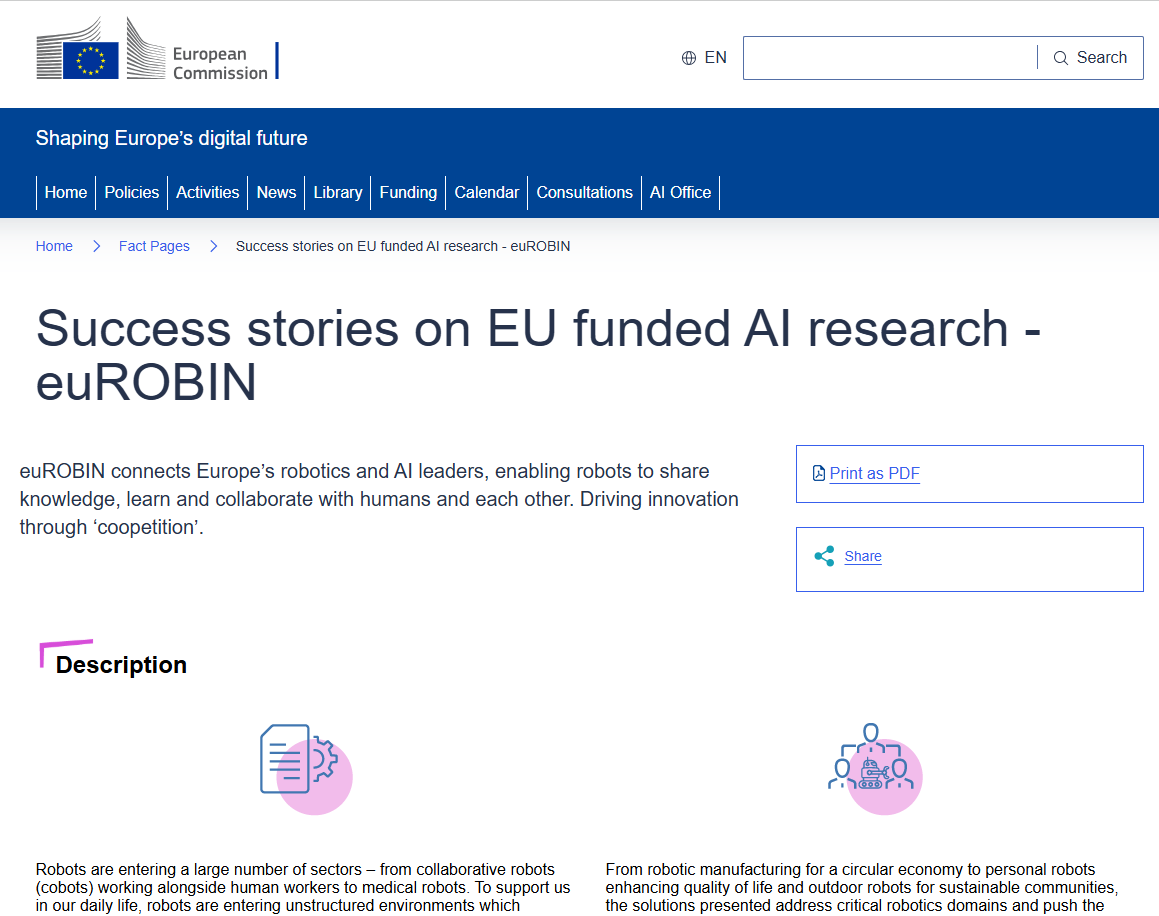
euROBIN project is on the website of the European Commission, a recognition that is an honour for all those who make the project possible and each of the partners who collaborate to achieve the goal: to improve the capabilities of robots through knowledge transfer methods, such as demonstration and digital communication, enabling robots to acquire new skills and expand their capabilities. The project relies on a strong network of European experts and technologies to create an ecosystem where robots share and learn from each other.
We are honoured that the European Commission speaks of euROBIN project as an ‘EU-funded AI research success story’.
Thank you all for enabling this success.
More information here.
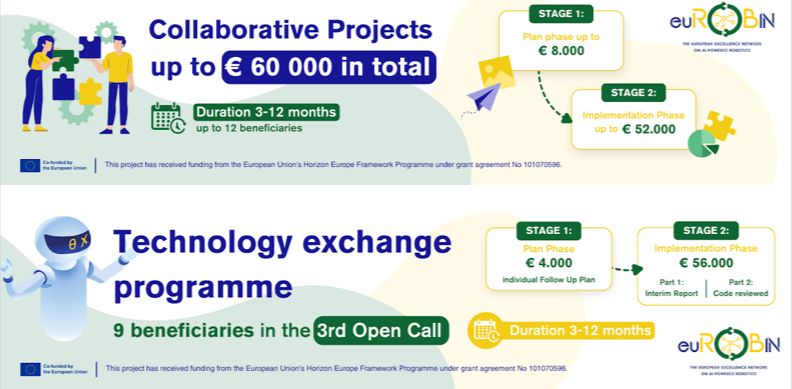
The euROBIN project launched last november 2024, two interesting Open calls, which we have now officially closed.
✔️ The 1st euROBIN Open Call for collaborative projects, which offered up to 60,000 euros to develop innovative software modules that allow robots to perform everyday tasks and interact seamlessly with humans.
- Applications initiated: 202
- Applications submitted: 65

The selected projects will benefit from a wealth of resources, including the European Repository for Robotic Code and Data (EuroCore). It offers various tools, datasets and software frameworks for creating and testing robotic solutions.
Applications have been received from a large number of different countries, with Italy being the country from which the largest number of applications have been received and accepted.

The challenge chosen by the applicant projects has been diverse, with Hyperspectral Camera Development for Textile Sorting as the first one.

✔️ The 3rd euROBIN open call offered the opportunity to collaborate with leading researchers and engineers, with funding of up to €60,000, to integrate and test their solutions on real robotic platforms.
- Applications initiated: 181
- Applications submitted: 52

The Technology Exchange Programme is designed to bridge the gap between innovative research and practical application. Successful applicants will have access to some of the most sophisticated robotic technologies in Europe, hosted by euROBIN's core teams.
Applications for this call also come from many countries, with Ukraine receiving the most applications.

In this 3rd call, the most selected challenge in the applications were two:
- Creation of manipulation tasks dataset with vision and language instructions.
- Datasets and algorithms for robot learning from simulated interactions.


Do you know the euROBIN EuroCore platform?
This platform fosters the development of transferable and reusable robotic solutions by enhancing collaboration and innovation in robotics and artificial intelligence (AI) across Europe.
How does it do this?
By providing a centralised repository for sharing software modules, data and knowledge in both robotics and AI.
Access to the euROBIN EuroCore platform

Thanks to this platform, innovations in these fields are also in line with European social, economic and environmental needs.
Click here if you want to know more about the impact of the euROBIN EuroCore platform.